
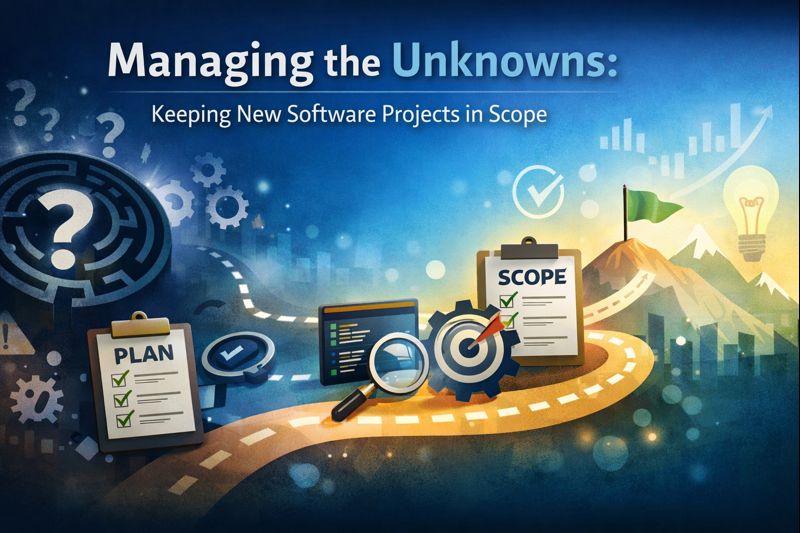
Starting a new software engineering project with a new client is always an exciting moment. There’s energy, ambition, and a shared belief that the solution being built will solve real business problems. At the same time, these early phases are where projects are most vulnerable to risk, because this is when the most assumptions are made and the least is truly known.
Even with strong discovery and well-written proposals, software projects are inherently complex. Requirements evolve, hidden dependencies emerge, integrations behave differently than expected, and real-world usage reveals gaps that no one could have predicted on day one. If these unknowns are not actively managed, they often lead to scope creep, missed timelines, budget pressure, and strained client relationships.
The challenge is not eliminating unknowns, that’s impossible. The challenge is building processes that acknowledge uncertainty and keep it under control as the project moves forward.
Why New Software Projects Go Out of Scope
Most scope issues do not come from poor intentions or careless planning. They come from the nature of software itself.
Unlike physical products, software is deeply interconnected with business processes, user behavior, third-party systems, data quality, and organizational constraints. Many of these factors only become visible once implementation begins.
Common drivers of scope expansion include:
- Features that were described at a high level but require far more complexity to implement.
- Legacy systems or APIs that behave differently than documented.
- Stakeholders realizing mid-project that they want different workflows or additional capabilities.
- Regulatory, security, or performance requirements emerging late.
- Edge cases discovered through testing and real usage.
From the client’s perspective, these often feel like reasonable requests. From the engineering perspective, they represent real additional work. Without a clear framework for managing this gap, projects drift beyond their original boundaries.
The Illusion of Complete Requirements
One of the most dangerous assumptions in software is that all critical requirements can be known upfront.
In reality, early requirements are usually a mix of:
- What stakeholders think they want.
- What they remember from previous systems.
- What they believe users will need.
- What the business hopes to achieve.
Only after prototypes, integrations, and early releases do teams start learning what actually works.
This doesn’t mean discovery is useless—far from it. Strong discovery dramatically reduces risk. But it should be viewed as risk reduction, not risk elimination.
Healthy teams treat initial requirements as a working hypothesis, not a fixed contract with reality.
Shifting from Fixed Scope to Managed Scope
One of the most effective mindset shifts is moving from “fixed scope” to “managed scope.”
Fixed scope assumes:
- The problem is fully understood.
- The solution is clearly defined.
- Deviations are exceptions.
Managed scope assumes:
- Some uncertainty is unavoidable.
- Learning will happen during delivery.
- Change is expected, but controlled.
This shift doesn’t mean abandoning discipline. It means designing governance that can absorb change without chaos.
Building Guardrails Through Phased Delivery
Large, monolithic project plans increase risk because they delay learning. When teams spend six or twelve months building before showing meaningful results, they lose opportunities to validate assumptions early and course-correct when needed.
Phased delivery introduces natural guardrails by breaking projects into smaller stages with tangible outcomes. Regular demos, working software, and short feedback cycles allow teams to test ideas in real conditions rather than theoretical ones.
Each phase becomes a checkpoint where priorities can be revalidated, technical feasibility confirmed, emerging risks identified, and scope decisions made consciously instead of reactively. Phased delivery transforms uncertainty into a managed, visible process rather than a hidden threat.
The Role of Continuous Communication
Most scope problems are not technical, they are communication problems. They arise when engineers assume clients understand the underlying complexity, clients assume features are “simple,” or important decisions are made verbally but never documented. Over time, these gaps accumulate into misaligned expectations.
Strong projects invest heavily in communication. Regular status updates, clear articulation of risks, and transparent discussions about effort versus value create shared understanding. Written summaries of decisions and scope changes provide a record that prevents ambiguity from creeping back in.
When communication is consistent and open, scope changes stop feeling like surprises. Instead, they become business decisions made with full visibility into their consequences.
Making Scope a Shared Responsibility
Scope should never be something managed by the engineering team alone. It works best when it becomes a shared responsibility across business stakeholders, product owners, engineering leads, and project management.
In this model, everyone understands the impact of changes, priorities are ranked rather than endlessly expanded, and tradeoffs are explicit. If something new enters scope, something else may need to leave, or timelines and budgets must adjust accordingly.
When scope is shared, trust grows. Difficult conversations become easier because they are grounded in mutual understanding instead of blame or frustration.
Using Data to Drive Decisions
Another powerful tool for controlling scope is data. Instead of debating changes emotionally or politically, teams can rely on effort estimates, risk assessments, dependency mapping, and technical constraints to inform decisions.
This shifts conversations from “Can we add this feature?” to “Yes, but here is what it costs and what it displaces.” Data reframes scope discussions as strategic tradeoffs rather than reactive compromises.
When decisions are backed by real information, they become easier to justify, easier to document, and easier to align across stakeholders.
Designing for Learning, Not Perfection
Perhaps the most important principle is that software projects should be designed for learning, not perfection. Early releases do not need to be flawless. They need to be useful, safe, and informative.
By treating early delivery as a learning instrument, teams can validate assumptions, reduce waste, focus on real user value, and avoid overengineering the wrong solution. Every iteration becomes an experiment that informs the next.
Learning early is far cheaper, and far less painful, than fixing late.
Connect with us at https://iq-inc.com/connect-with-us/ or info@iq-inc.com to start the conversation.
#SoftwareEngineering #ProjectManagement #ProductDevelopment #DigitalTransformation #TechLeadership #ScopeManagement #EngineeringLeadership #Agile